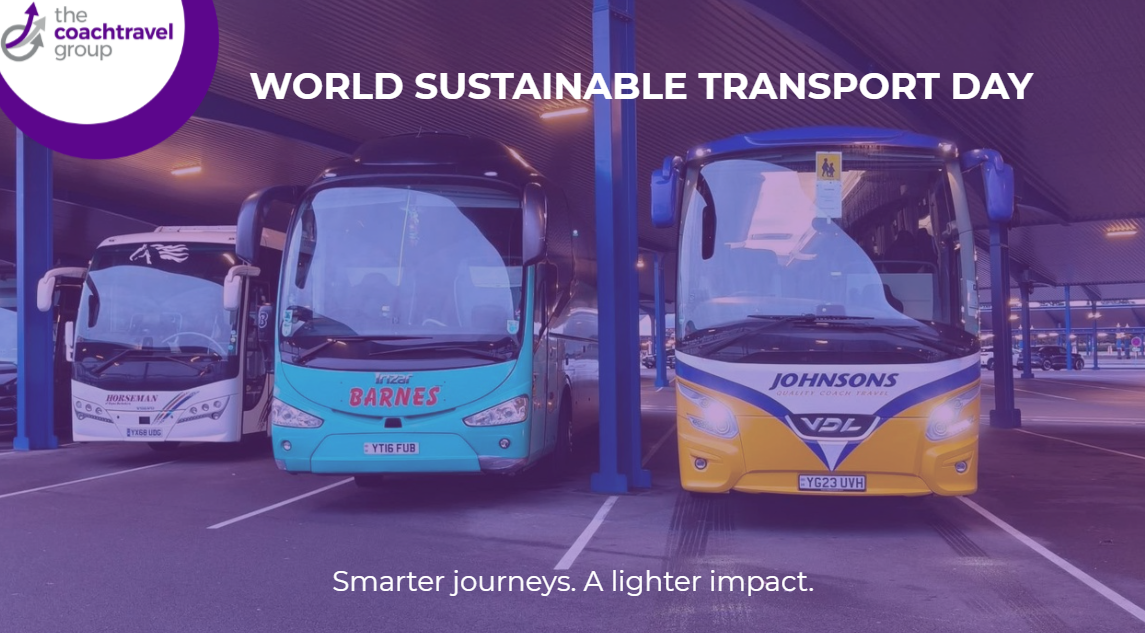
World Sustainable Transport Day. What are CTG doing?
25th November 2026
Working Together for More Sustainable Coach Travel
Small changes to make smarter Journeys with a lighter Impact.
At The Coach Travel Group, we believe that making coach travel more sustainable starts with working together.
With operators located across the UK, we have the advantage of combining local knowledge with the resources and expertise of a wider national network. This allows us to make smarter decisions about how we manage our vehicles, plan journeys and deliver transport services, helping to reduce unnecessary mileage and improve operational efficiency.
This World Sustainable Transport Day, we’re highlighting some of the initiatives taking place across The Coach Travel Group, celebrating the progress our operators are making and looking at how we can continue working towards a more sustainable future.
Investing in Cleaner Vehicles
Investing in modern, more efficient vehicles is an important part of our approach to sustainability. Our operators have continued investing in modern coaches equipped with Euro 6 engines, helping to reduce harmful exhaust pollutants and improve air quality.
These engines meet stringent European emissions standards, particularly for nitrogen oxides and particulate matter, helping us deliver reliable and comfortable transport while reducing the impact of vehicle emissions on the environment.
Coatham Coaches currently operates 2 fully electric coaches and is the only coach operator in the North East to offer electric coaches, demonstrating their commitment to reducing emissions in the region.
Meanwhile, Stewarts Coaches operates five electric ADL double-decker buses, helping to support contracts with specific sustainability requirements while providing a cleaner, lower-emission transport solution for customers.
These investments highlight how our operators are embracing new technologies and working towards a more sustainable future for coach travel.
Working Together to Make Better Use of Our Fleet
One of the biggest advantages of being a national group is our ability to work together across our network of operators. Rather than just operating independently, our teams can share vehicles, resources and expertise to meet customer requirements more efficiently.
By supporting one another during busy periods and making use of vehicles already positioned closer to customers, we can reduce unnecessary journeys, improve vehicle utilisation and minimise avoidable fuel consumption.
For Barnes Coaches, this collaborative approach had delivered significant results:
- 83,247 miles of unnecessary vehicle travel avoided
- Reduced fuel consumption through more efficient vehicle allocation
- £679,000 in operational savings through improved efficiency
Smarter Journey Planning: Making Every Mile Count
Sustainability isn’t just about the vehicles we operate. It’s also about how we plan to use them. Across the group, our operators are continually looking for opportunities to improve journey planning, vehicle allocation and fleet utilisation.
By considering passenger requirements, vehicle availability and depot locations, we can identify the most suitable coach for each booking while reducing unnecessary mileage.
For example: If a coach is allocated from a depot 30 miles away, but another operator has a suitable vehicle available just 10 miles from the collection point, reallocating that journey could save 20 miles of unnecessary positional travel.
Our London and South East operators, Horseman Coaches, Stewarts Coaches and Readybus, are putting this approach into practice through improved vehicle allocation and regional journey planning.
By eliminating just 20 miles of unnecessary vehicle travel per day across three operators, over 260 working days, the potential annual savings are:
- 15,600 fewer vehicle miles travelled.
- 17.8 tonnes of CO₂ emissions avoided.
- Equivalent to approximately four average petrol-powered cars' annual greenhouse gas emissions.
Discover more about what CTG LSE are doing:
The People Behind Efficient Coach Travel: Sonny Brown
What We're Doing to Make Coach Travel More Sustainable
Making Holiday Travel More Efficient
Another example of smarter transport planning comes from Barnes Coaches, where smaller feeder vehicles help connect customers with their main holiday or day-trip coach.
Rather than requiring a full-size coach to travel between numerous collection points, smaller vehicles collect passengers locally and bring them together at a central departure point. Helping reduce unnecessary milage by avoiding multiple journeys along similar routes and improve fuel efficiency through more effective user of small vehicles and full-size coaches.
Travel Together. Reduce The Need for Multiple Cars
While we’re continually improving how we operate behind the scenes, coach travel itself offers an important environmental advantage: bringing more people together in fewer vehicles.
Since the beginning of 2026, Johnsons Coaches and Whittles have carried 21,598 combined passengers. To put that into perspective, that’s the equivalent of more than 4,319 fully occupied five-seater cars’ worth of passengers.
Moving Towards a More Sustainable Future
At The Coach Travel Group, we recognised that making transport more sustainable is an ongoing commitment. From investing in cleaner vehicles and improving journey planning to sharing resources across our network, every improvement contributes towards a more efficient operation.
By working together, sharing ideas and continually looking for opportunities to improve, we can make meaningful progress towards reducing our environmental impact.
